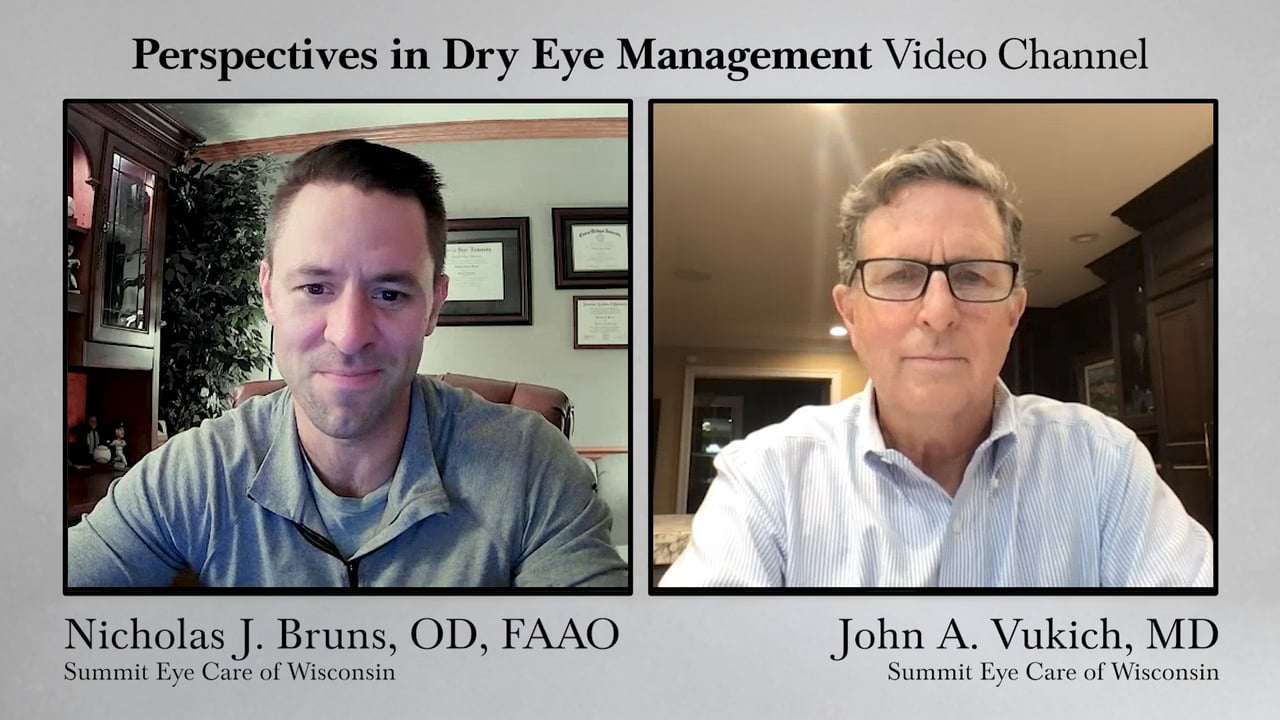


Episode 1: Mitch Shultz, MD, of Shultz Chang Vision, and Harout Khanjian, OD, of California Eye Center Optometry, discuss TFOS DEWS III and the new ways they are approaching treatment for dry eye patients.
What follows is a lighty edited transcript of the conversation:
Mitch Shultz, MD: I'm Dr. Mitch Schultz and I'm here with my great friend Harout Khanjian. And we're going to talk about dry eye and some of the new interesting medications that we have out there as it relates to the recent TFOS recommendations that have come out over the past year. Harout, why don't you talk a little bit about the TFOS DEWS III data that just came out back in December?
Harout Khanjian, OD: The TFOS DEWS report, the last one we saw came out in 2017. And the new one that just came out definitely has a lot of new stuff in there that we didn't really talk about back in 2017 where we're now starting to look at the tear film a little more closely, the eyelids, the lashes. There's all sorts of implications when it comes to dry eye and everybody's dry eye is a different kind of dry eye. And there's so many different treatment modalities when it comes to treating dry eye. And there's not one magical drop, use this and all your signs and symptoms are going to be resolved.
So what's really interesting is that we're now starting to look at neuromodulators versus immunomodulators. And when we talk about neuromodulators, what's really fascinating is that for now we're starting to think about an eye drop that can actually target our basal tear production.
So when we talk about our basal tear production, we're talking about our natural tears. And we know there's over 1,000 different proteins, there's over 500 types of different lipids, and there's over at least 8 different type of mucin types on our tear film. So what better than to use or start focusing on a medication that can actually start producing more of our natural tears?
So that's what really stood out for me in this TFOS DEWS III is that we're now looking at all sorts of other stuff and new treatment modalities that we weren't considering since 2017. A lot has really changed that we can definitely incorporate in our clinic on a day-to-day approach.
Dr. Shultz: It was literally 8 years between the different reports. And I think in these past 8 years, we've seen so many different medications come onto the market. We for years just had multiple anti-inflammatory medications coming out. And then we had neuromodulators, but as you know, we had a nasal spray neuromodulator previously that a lot of patients didn't really like. I mean it caused sneezing, burning, irritation, bloody noses, things like that.
So now having an eye drop neuromodulating medication that really is effective. So we're creating this basal tear secretion so that we're allowing the patient's eyes to perform the way they're supposed to as opposed to just throwing something on there that kind of palliates symptoms.
So when we talk about anti-inflammatory medications and even we talk about our tear film stabilizing medications, they're really just palliating. So they're reducing inflammation, but they're not actually being proactive in managing dry eye and managing the ocular surface. So obviously with TFOS, we're talking about managing the ocular surface. And what better way to do that than to create the most healthy tear possible for our patients?
So tell me a little bit about when you see a patient that comes in with dry eye, what you're thinking about before you actually get them to me.
Dr. Khanjian: So our profession has changed and optometry really has taken a step forward in becoming more of the primary eyecare physician. And so when that patient walks through the door, I’ve got to make sure they don't have glaucoma. I’ve got to make sure there's no macular degeneration. I got to make sure there's no dry eye.
When we're doing our examinations, we have to look for dry eye because that's going to be the foundational beginning toward if I'm going to give them glasses and they're going to have a good outcome on their glasses, or if I'm going to fit them for contact lenses, if they're going to tell me that these contact lenses don't really fit right. Or if I'm going to send them down in about a month or 2 to be scheduled for cataract surgery, I now have a certain amount of time to start working on that tear film so that I can have you be able to have good pre-op measurements. So dry eye now has become an incredible foundational starting point when it comes to what we want to do with this patient.
So much now is on my plate to make sure that that patient is going to have an excellent outcome. So what better in this tool shed of dry eye medications that we have now is for us to now be able to have more options in being able to create a better outcome for the patient.
Dr. Shultz: I would agree. It's so critical because we do so much cataract surgery today. We do a lot of refractive cataract surgery today. Our patients are choosing. They don't want to wear spectacles after surgery. And those patients, we need to make sure the ocular surface is pristine before we do surgery because every step of the way affects not only the magnitude of when we're looking at astigmatism preoperatively. If the ocular surface is dry, it can affect the surface by up to 2 diopters.
So it could be a huge swing. It can create all kinds of refractive surprises if we're not careful about taking care of the ocular surface. I don't hesitate.
And so whenever we see patients coming in for cataract surgery, we do tear film analysis on all of them. And if I see that the tear film is not stable, if the tear film is low, if we see hotspots on the cornea, we see funny topography. Typically if a patient has dry eye or ocular surface abnormalities, we'll see a blue area flattening, which means that there's an absence of tear film in that area. That's a major indicator of dry eye when we're looking at topography. So we need to manage those things upfront.
And that can be a combination of different eye drops. But we also have to manage eyelid disease too. So that's also part of TFOS, is managing the ocular surface looking for things like demodex that can affect the meibomian glands and cause inflammation, not just looking at our tear film, but we have to look at the whole picture and manage all of those things before we do surgery. And I think when we do that, that's how we get to better outcomes.
There’s been several different studies that have looked at different medications, both in the neuromodulators as well as the tear film stabilizers and the anti-inflammatories. But all of them tell us that if we manage the ocular surface before surgery we can increase the number of patients that aren't good candidates for a premium IOL and make them candidates for premium IOLs.
Dr. Khanjian: And it's not just until getting them to the surgery room. It's maintaining that good outcome afterwards. And once we get them off those 6 weeks of post-cataract drops, that's usually when we start hearing the complaints. "It's sticky around the edge of my eyelids. I'm getting this tearing. I'm getting the sand-like sensation." And then at that point we should get into the mindset of ‘what can I do now is after these post-op drops are done, let's get them into something that's going to help them continue this good outcome and help them continue this good vision.’
What I really liked about the TFOS III report is back to what you said about focusing on the fundamentals. So we talked about tear film and also back to the eyelids and lashes. We're talking now about Demodex. We're talking about blepharitis. We've never used to really have these conversations before. But now we're understanding that the health of the eyelid does directly affect the outcome of the best corrected visual acuity.
Moving forward, I'm pretty sure if we were to hear about a TFOS IV report, I'd probably predict that we're looking into more foundational such as diet. We did see that in TFOS III report. They were talking about okra eyelid cleansers and all sorts of things that kind of point toward an organic, natural-like way of treating and healing. Our diet, exercise, our environment, our computer uses, all of that now is becoming a question when it comes to patients' complaints with dry eyes and issues. Are you seeing any of that in your practice, Dr. Schultz?
Dr. Shultz: Well, of course. Our practice is focused on the anterior segment. So we deal with lots of ocular surface disease, pterygiums. We have a lot of glaucoma patients that we have to manage who are on multiple medications. So the goals obviously today are to reduce the number of medications, certainly medications that have preservatives.
And I think as we continue to move forward, it's really an exciting space. Our goal is to get people out of glasses, off of drops, or certainly as healthy as possible, get their ocular surface back to normal so they can continue to do the activities that are important to them.
Dr. Khanjian: Absolutely. Get them back and going and living life and moving forward. Nothing better than that. So looking forward to newer treatments, of course, and hoping that as science progresses and we can learn more about our tear film and the many, tiny nuances in the tear film that if not correct, can definitely lead to all the discomfort with the dry eye symptoms that patients are experiencing day in and day out.
Dr Shultz: This was a pleasure. I really appreciate the opportunity, Harout, for us to get time together.
Dr. Khanjian: Likewise.
Dr.Shultz: Anyways, thank you. And thank you everybody for taking the time to listen to us.